Flat Head Syndrome · Condition Guide
What Is
Plagiocephaly?
Plagiocephaly — also known as flat head syndrome — is when a baby's head develops a flat spot or becomes misshapen due to prolonged pressure on the soft skull. It's more common than most parents realize.
In Infants
When Started Early
Largely Sets By Age
Head Shape Types
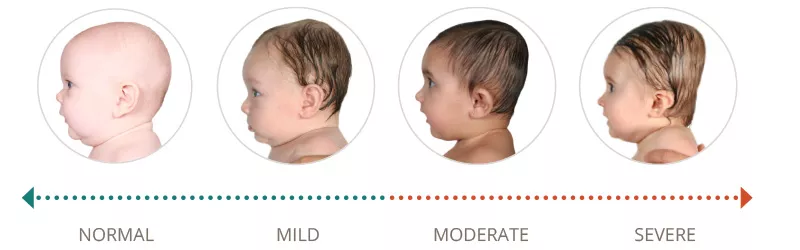
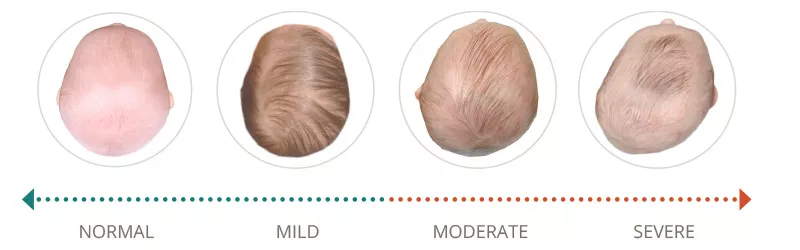
What Does Plagiocephaly Look Like?
Parents spend so much time with their baby, recognizing an abnormal head shape can sometimes be difficult. Head shapes range from mild to severe and can occur in combination. Here are the three most common presentations.
Plagiocephaly
The back of the head is flat on one side, giving an asymmetric appearance when viewed from above.
- Back of head flat on one side
- Head appears skewed from above
- Ear misalignment
- Asymmetric facial features
Brachycephaly
The back of the head is flat across the entire width, making the head look wider and shorter than normal.
- Head wider than normal
- Back of head flat, lacks curvature
- Face may look small for head size
Combination
A mix of both plagiocephaly and brachycephaly traits, often presenting with added height to the skull.
- Head wider and taller than normal
- Forehead is sloped
- Ears and eyes appear misaligned
- Trapezoid shape when viewed from above
Risk Factors
What Causes Plagiocephaly?
Babies' heads are soft and sensitive to even gentle, sustained forces — whether applied in the womb or through daily positioning habits after birth, these forces applied to the baby's skull can cause deformity.

Back Sleeping
Prolonged pressure on the back of the skull during sleep is one of the most well-documented causes of flattening.

Restrictive Devices
Car seats, smart sleepers, rockers, and strollers limit natural movement and contribute to extended back-lying time.

Torticollis
Tight neck muscles on one side tilt the head toward the tightness and rotate it away, creating a positional preference.

Premature Birth
Premature babies have especially soft skulls and often spend extended NICU time with the head in a fixed position.

Womb Positioning
Babies stuck in a singular position in the womb — including breech orientation — are at risk for abnormal head shape.
Twins or Multiples
Limited space in utero for twins and higher-order multiples increases the risk of skull distortion before birth.
Treatment Timing
When Should Treatment Begin?
Flat spots can develop in as little as one week. The earliest months coincide with the most head growth — making early intervention the most effective strategy.
| Age at Start | Average Treatment Time |
|---|---|
| Under 4 months | 5–7 weeks |
| 4 months | 6–9 weeks |
| 5 months | 8–10 weeks |
| 6 months | 2.5–3.5 months |
| Over 7 months | 3.5–4 months |

Why Age Is a Critical Factor
At birth, babies have very soft, malleable skulls — this flexibility helps them through the birth canal. A baby's head doubles in size within the first 6 months. By age 2, brain growth slows significantly and head shape mostly sets for life.
Will Flat Spots Go Away on Their Own?
Repositioning can sometimes correct mild flatness in babies up to 4 months old. However, research shows that moderate-to-severe plagiocephaly is unlikely to self-correct without treatment.
No Effect on Brain Development
Plagiocephaly is not known to cause any lasting or harmful effects on a baby's neurological development. It is a physical condition affecting head shape only.
Treatment Options
How Is Plagiocephaly Treated?
First, it's important to confirm the flat spots are positional — caused by external pressure. Conservative measures are the starting point; moderate-to-severe cases typically require helmet therapy.
Tummy Time
Reduces time spent on the back while awake. Builds core motor strength and encourages independent head movement and rolling.
Reposition the Head
Turning the head during sleep or in a convenience device reduces pressure on existing flat spots and prevents new ones from forming.
Hold Your Baby
Reduces time in restrictive devices and allows the baby to freely shift head position throughout the day.
When Is Helmet Therapy Recommended?
No improvement after repositioning, tummy time, or physical therapy
Baby is 4–6 months old and flat spots have not improved over time
Baby is older than 3 months with moderate-to-severe plagiocephaly
Baby is older than 6 months and flat spots continue to persist

Common Questions
Frequently Asked Questions
Parents often have the same questions. Here are the answers to what families ask us most.
Will plagiocephaly affect my baby's brain development?
Plagiocephaly is not known to cause any lasting or harmful effects on a baby's neurological development. It is a physical condition involving head shape only.
Will flat spots go away on their own?
Repositioning can sometimes correct mild flatness in babies up to 4 months old. Research shows that moderate-to-severe cases are unlikely to self-correct without intervention.
Should I still put my baby to sleep on their back?
Yes — back sleeping remains the safest position to reduce SIDS risk. Manage plagiocephaly risk with supervised tummy time when awake and repositioning techniques during sleep.
Is plagiocephaly preventable?
Some risk can be reduced with regular tummy time, limiting time in restrictive devices, and repositioning during sleep from an early age. Not all cases are preventable.
How do I know if my baby needs helmet therapy?
If repositioning and tummy time haven't improved the flat spot by 4–6 months, or if the case is considered moderate-to-severe by a specialist, helmet therapy is typically recommended.
Is plagiocephaly common?
Yes — it affects approximately 47% of infants, with 1 in 4 babies having a severe case. It is one of the most common conditions seen in cranial orthotics practices today.
Get Started
Head Shape Concerns? We Can Help.
Our specialists offer no-cost evaluations to assess your baby's head shape and recommend the right next steps — with no obligation.
Research
- Mawji A, et al. The incidence of positional plagiocephaly: a cohort study. Pediatrics. 2013 Aug;132(2):298-304.
- Lennartsson F, Nordin P. Nonsynostotic plagiocephaly: a child health care intervention in Skaraborg, Sweden. BMC Pediatrics, 2019. 19(1): p. 48.
- Hutchison BL, et al. Plagiocephaly and brachycephaly in the first two years of life: a prospective cohort study. Pediatrics, 2004. 114(4): p. 970-980.
- Ballardini E, et al. Prevalence and characteristics of positional plagiocephaly in healthy full-term infants at 8-12 weeks of life. Eur J Pediatr, 2018. 177(10).