How to Check for Flat Head Syndrome
To better understand irregularities, let's start with what a typical baby head shape looks like.
Here are the general guidelines.
- The head is 1/3 longer than it is wide
- The ear canals are in alignment with one another
- There is no visible asymmetry or disproportion of the facial features
 Normal head shape – 3 months old
 Normal head shape – 6 months old
 Normal head shape – 9 months old
Place your baby in yours or someone else's lap so you have a good view of the top of their head. You may notice flatness on either one side, or the entire back of the head. The head is typically 1/3 longer than it is wide, and if you were to draw a line down the middle, the left half should look the same as the right half.
- Flatness on one side of the head
- Resembles a parallelogram or trapezoid-like shape
- Ears are out of alignment with one another
- Head is wider than it is long
- Back of the head appears flat rather than curved
 Normal
 Plagiocephaly
 Brachycephaly
 Scaphocephaly
Normally, the back of the head is curved and both sides of the head will match both in symmetry and proportion. So for this step, we'll want to focus on the back of the head, and the forehead.
- One side of the head appears more curved than the other
- The back of the head looks flat
- The back of the head looks tall with a slope forward
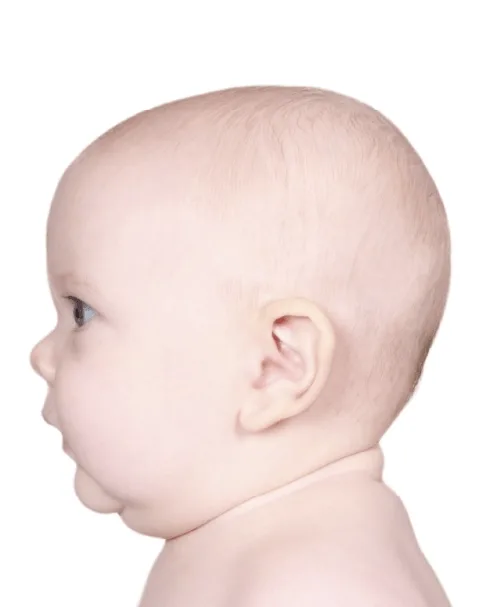 Normal
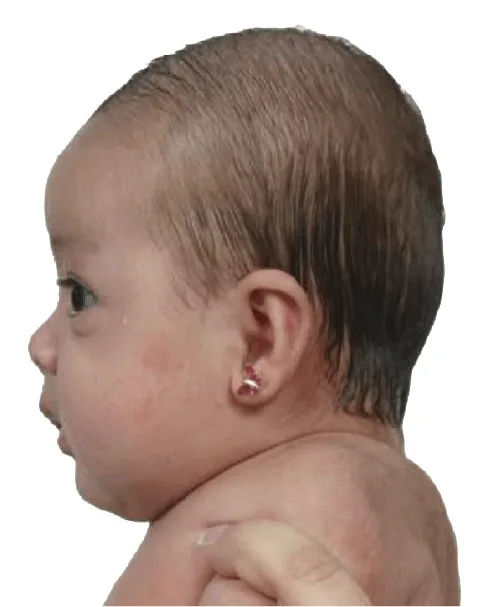 Plagiocephaly
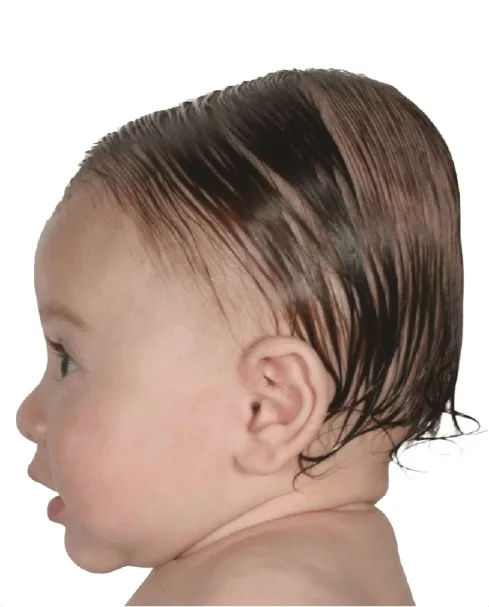 Brachycephaly
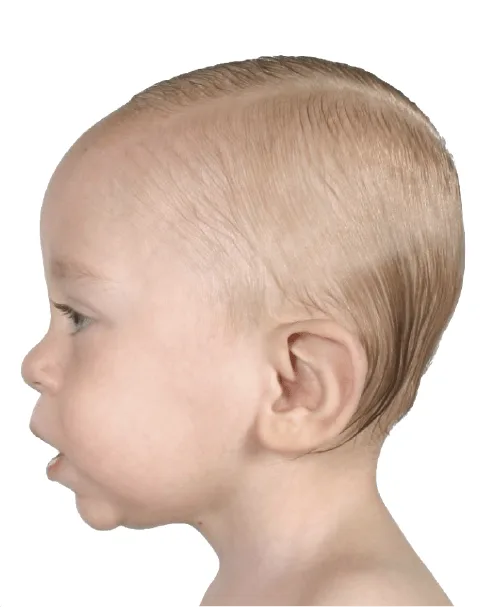 Scaphocephaly
Typically, asymmetry of the facial features is related to plagiocephaly or is a component of plagiocephaly. The ear alignment test or the Argenta Method is a great way to check for misalignment from a visual standpoint.
- Hold the baby in your own lap, sitting upright.
- Gently place your index finger at each of the ear canals (as pictured above).
- Ensure that you're looking directly down at the head to get a good angle.
- Observe the alignment of your index fingers across the head (On the x-axis, imagining a line straight across).
- Look for any misalignment between the index fingers.

However, it's important to keep in mind that flat spots won't always cause asymmetry in the facial features. Therefore the ear alignment test is usually a good indicator for plagiocephaly, but may not always paint the full picture.
Since you see your baby's face every day, it can be easy to miss gradual changes to their facial features. Place your baby in front of a mirror, this will make it easier to see asymmetries.
- One eye is smaller than the other, or one cheek is fuller
- The head height is not level, or there is sloping
- Eyes are not level to one another
- The mouth is asymmetric, or appears "slanted"
- Head appears wide, and the widest part is just above the ears.
- Face appears small relative to the size of their head
- The tips of the ears slant downward
 Normal
 Plagiocephaly
 Brachycephaly
 Scaphocephaly
How do I know if my baby needs helmet therapy?
If repositioning and tummy time haven't improved the flat spot by 4 months, or if the case is considered moderate-to-severe by your pediatrician or PT, helmet therapy is typically recommended.
When is the right time to seek help?
Data shows that time matters more than most parents realize. Early intervention leads to shorter treatment, fewer visits, and successful outcomes. We can treat infants up to 18 months, but overall outcomes improve when treatment is started between 4-6 months.
Is plagiocephaly preventable?
Some risk can be reduced with regular tummy time, limiting time in restrictive devices, and repositioning during sleep from an early age. Not all cases are preventable.
Will flat spots go away on their own?
Repositioning can sometimes correct mild flatness in babies up to 4 months old. Research shows that moderate-to-severe cases are unlikely to self-correct without intervention.
Is plagiocephaly common?
Yes — it affects approximately 47% of infants, with 1 in 4 babies having a severe case. It is one of the most common conditions seen in cranial orthotics practices today.
Should I still put my baby to sleep on their back?
Yes — back sleeping remains the safest position to reduce SIDS risk. Manage plagiocephaly risk with supervised tummy time when awake and repositioning techniques during sleep.
Quick Links

What is Helmet Therapy?
Learn how the DOC Band® gently redirects head growth into a rounder, more symmetrical shape.
Insurance & Coverage
Learn how the DOC Band® is covered, verify your benefits, and explore flexible payment options.
The Treatment Process
See what to expect from your first visit through graduation, step by step.
Patient Results
Browse our before-and-after gallery from families who completed treatment.